What You’ll Learn from This Case Study
In this comprehensive case study, you’ll discover:
- Why coffee mugs are the best POD product for passive Amazon income
- Real profit margins and cost breakdown for selling mugs on Amazon
- Amazon account setup including GTIN exemption and shipping configuration
- Supplier selection strategy (why CustomCat beats FBA for POD mugs)
- Design creation secrets using simple text templates across 500+ niches
- The Evergreen Ads Method for running hundreds of campaigns profitably
- Actual results from 1,240 orders generating $4,000+ in profit
If you want a side hustle that makes money on Amazon while you sleep, print on demand is one of the easiest ways to start.
Print on demand (POD) means you don’t buy inventory upfront. Instead, when someone places an order from your Amazon store, the product is printed, packed, and shipped by a supplier on your behalf. No boxes in your garage. No trips to the post office. No risk of being stuck with unsold stock.
In this case study, we focus on selling coffee mugs because:
- They’re affordable gifts.
- Everyone uses them daily.
- They’re easier to sell than most other POD products since buyers instantly understand their value.
I’ll walk you through the exact system I use to upload products in bulk, run ads, and generate sales on Amazon without ever touching inventory.
Along the way, I’ll also reveal my ad strategy — called The Evergreen Ads Method — which allows me to run hundreds of campaigns without wasting money, while still bringing in consistent sales.
By the end, you’ll see how this approach can help you build a mug business on Amazon that delivers passive sales day after day with PODtomatic’s automation tools.
Why Selling Mugs on Amazon?
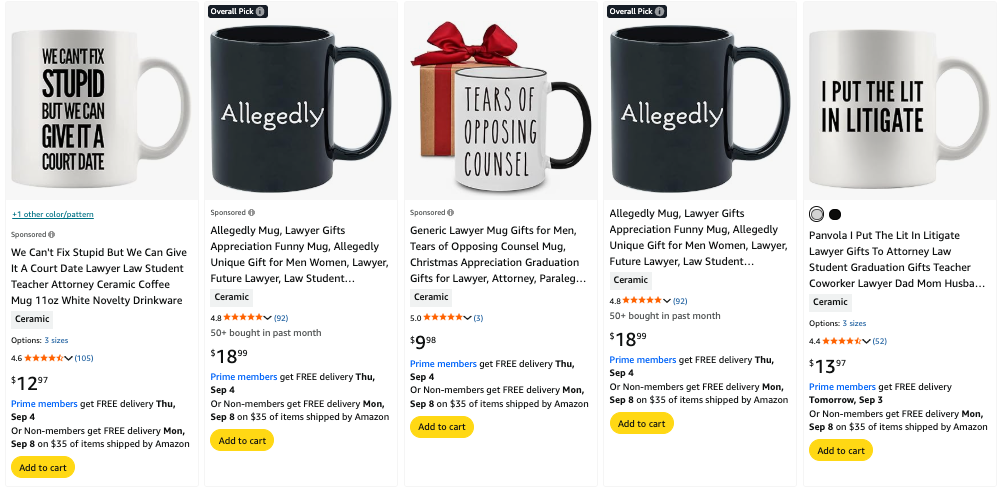 Example of successful print-on-demand mugs on Amazon with various designs and price points
When people shop on Amazon, they’re often looking for gifts. And most of the time, those gifts fall into the “under $20” category. Coffee mugs fit perfectly into this sweet spot:
-
Affordable gift range: With mugs priced between $16.95–$24.95, they’re cheap enough for impulse buys yet valuable enough to give as presents.
-
Everyday use: Everyone already knows what a coffee mug is and how they’ll use it, so there’s no need to “educate” the customer.
-
Unlimited niches: A simple text design can instantly be turned into a gift for teachers, nurses, engineers, gamers, or any other group of people.
That combination — affordable price, high demand, and endless niche possibilities — makes mugs one of the best print on demand products to sell on Amazon.
Pro Tip: The key to success isn’t one “winning design” — it’s building a system that covers hundreds of niches simultaneously. Learn how PODtomatic automates this process.
Costs & Profit Margins
To list products on Amazon, you’ll need a Professional Seller account, which costs $39.99 per month. This gives you access to all the features you need to sell at scale.
Next comes the product itself. With CustomCat as my supplier, the base cost of a mug — including shipping to the customer — is around $10–15, depending on the style.
On the customer side, I price my mugs between $16.95 and $24.95, which fits perfectly into Amazon’s “under $30 gift” sweet spot. I also charge $4.95 for shipping per mug.
Example: Mug Profit Calculation
- Selling price: $16.95
- Shipping charged: $4.95
- Total revenue: $21.90
- CustomCat cost (mug + shipping): ~$10.00
- Amazon fees (~15%): $3.30
- Net profit per mug: ~$8.60
That leaves me with an average profit of $10–15 per mug, which works out to roughly 40–60% profit margins depending on the style and price point.
Now, $10–15 per sale might not sound huge at first, but remember — mugs are everyday items and popular gifts. Once you have hundreds of designs live, those small profits start stacking up into real, passive income.
Amazon Account Setup (Beginner Essentials)
Before you can start listing and selling mugs, you’ll need to set up your Amazon Seller account properly. Here’s how to do it step by step:
1. Sign Up for an Amazon Seller Account
The first step is to create an Amazon Professional Seller account. It costs $39.99 per month, but the features you unlock are worth it if you’re planning to scale.
It may take a few days for Amazon to verify your details, so don’t worry if you don’t get approved immediately.
2. Verify Your Phone and Address
After signing up, Amazon requires you to verify your phone number and business address. Without completing this step, your products won’t go live.
- Go to Settings > Account Info > Business Information > Business Address and Phone Number.
- Amazon will send you a postcard with a verification code.
- Once the postcard arrives, enter the code in your Seller account.
- When successful, you’ll see the message: “Address Verified Successfully.”
Important Note: You can continue with the next setup steps while waiting for the postcard to arrive.
3. Request a GTIN Exemption
Normally, Amazon requires every product to have a UPC barcode. With print on demand, that’s not possible — so you need to request a GTIN Exemption.
The process is free, takes just a few minutes, and once approved, you can list products without needing barcodes.
Step-by-Step Guide: For detailed instructions with screenshots, check out our complete GTIN Exemption Guide.
4. Set Up Shipping on Amazon
Now it’s time to configure your shipping settings.
- Go to General Shipping Settings and set your Default Shipping Address to match your POD supplier’s U.S. address. This ensures your listings meet Amazon’s delivery time expectations.
Example supplier address:
- CustomCat: 1300 Rosa Parks Blvd. Detroit, MI 48216
Since I use CustomCat, I set the default shipping address to their U.S. location so Amazon recognizes short delivery times.
-
After that, go to Shipping Templates and make sure the delivery time is under 7 days.
-
Adjust your shipping fees. I recommend charging $4.95 per order and $2 per additional item.
Once you’ve completed these steps, your Amazon Seller account will be fully set up and ready to start listing products.
Supplier Choice: Why We Use CustomCat
 CustomCat - The print-on-demand supplier used for fast Amazon fulfillment
Once your Amazon account is set up, the next step is choosing a reliable print-on-demand supplier. The supplier you pick determines not just the quality of your products, but also how quickly they reach your customers. And on Amazon, fast shipping is everything.
💡 Key Insight: FBM Can Compete with FBA
Most sellers think that only FBA (Fulfilled by Amazon) products can rank well. But here’s the secret: if your FBM (Fulfilled by Merchant) products ship quickly, Amazon will still reward you. Fast shipping builds trust with Amazon, and that trust translates into better rankings in search results.
That’s why I use CustomCat as my main supplier for mugs:
Fast Production & Shipping
CustomCat produces mugs in about 2–3 days and ships directly to customers. This speed allows FBM products to compete head-to-head with FBA listings, since Amazon prioritizes sellers who deliver reliably.
Consistent Quality
Customers won’t tolerate poor print quality. CustomCat consistently delivers sharp, professional-looking designs on durable mugs, which keeps buyers happy and minimizes returns.
Scalability
Whether you sell a handful of mugs or thousands, CustomCat has the production capacity to keep up. This matters once you scale across multiple niches and campaigns.
In short, CustomCat gives you the speed of FBA with the flexibility of POD. Their fast turnaround ensures your mugs meet Amazon’s delivery expectations, which means your FBM listings can rank like FBA products — without the storage fees or inventory risks.
Creating and Uploading Mugs to Amazon
With your Amazon account ready and your supplier chosen, it’s time to move on to the most important step: creating and listing products on Amazon.
The strategy here is simple: don’t rely on one design or one niche. Instead, focus on uploading lots of mugs across many different niches. Why?
-
More chances to get found: Each mug listing is like a lottery ticket. The more you have, the higher the chance one of them takes off.
-
Small niches add up: A single niche (like nurses, teachers, or gamers) might not bring in huge sales by itself, but when you combine hundreds of niches, the results stack up.
-
Free organic traffic: Many small niches on Amazon have low competition. By listing mugs in those spaces, you can capture free search traffic without needing to outspend bigger sellers.
-
Passive sales machine: Once your mugs are listed, they stay live on Amazon 24/7. Even while you sleep, your designs can be discovered and purchased.
This is the foundation of my approach: create a large catalog of mugs across a wide range of niches, and let Amazon’s massive search engine do the heavy lifting.
Creating Designs (No Graphic Skills Needed)
When it comes to mugs, simple designs sell best. You don’t need fancy graphics or complex illustrations — in fact, the top-selling mugs on Amazon are usually just clean, text-based designs with a clever quote.
One of my favorite approaches is using repeatable templates like:
“Keep Calm, I’m a [Niche]”
With this one format, you can instantly create hundreds of variations:
- “Keep Calm, I’m a Nurse”
- “Keep Calm, I’m an Engineer”
- “Keep Calm, I’m a Teacher”
…and so on across 500+ niches.
The beauty of this method is that you don’t need Photoshop skills or a design background. All it takes is a nice font, centered text, and a phrase that connects with the niche.
To make this process even faster, you don’t have to design each mug from scratch. You can create one template in a tool like Canva or Photoshop, then simply replace the niche keyword. For example, swap “Nurse” for “Teacher,” “Engineer,” or “Gamer,” and in just a short time you’ll have hundreds of unique designs ready to upload.
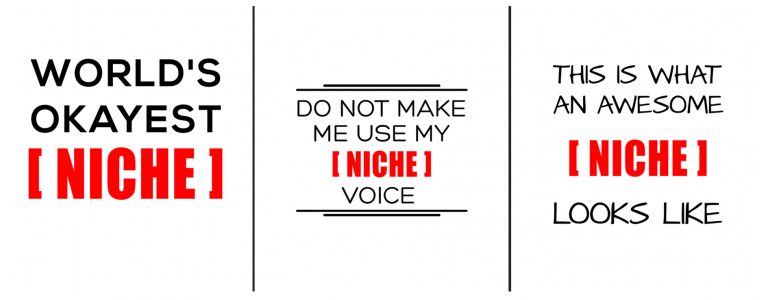 Simple design templates showing how to create multiple niches using the same layout
Key Takeaway: You don’t need to be a designer to sell mugs on Amazon. With simple text-based quotes and a repeatable template, you can quickly build a catalog that covers hundreds of niches.
Creating Product Photos Without Photoshoots
Another great thing about print-on-demand is you don’t need to spend money on photographers or product samples just to get pictures for your listings. Instead, you can use mockups — digital product images where your design is placed onto a mug template.
You can buy high-quality mug mockups from places like Etsy or CreativeFabrica. These polished images look professional and trustworthy, which is important for building buyer confidence on Amazon.
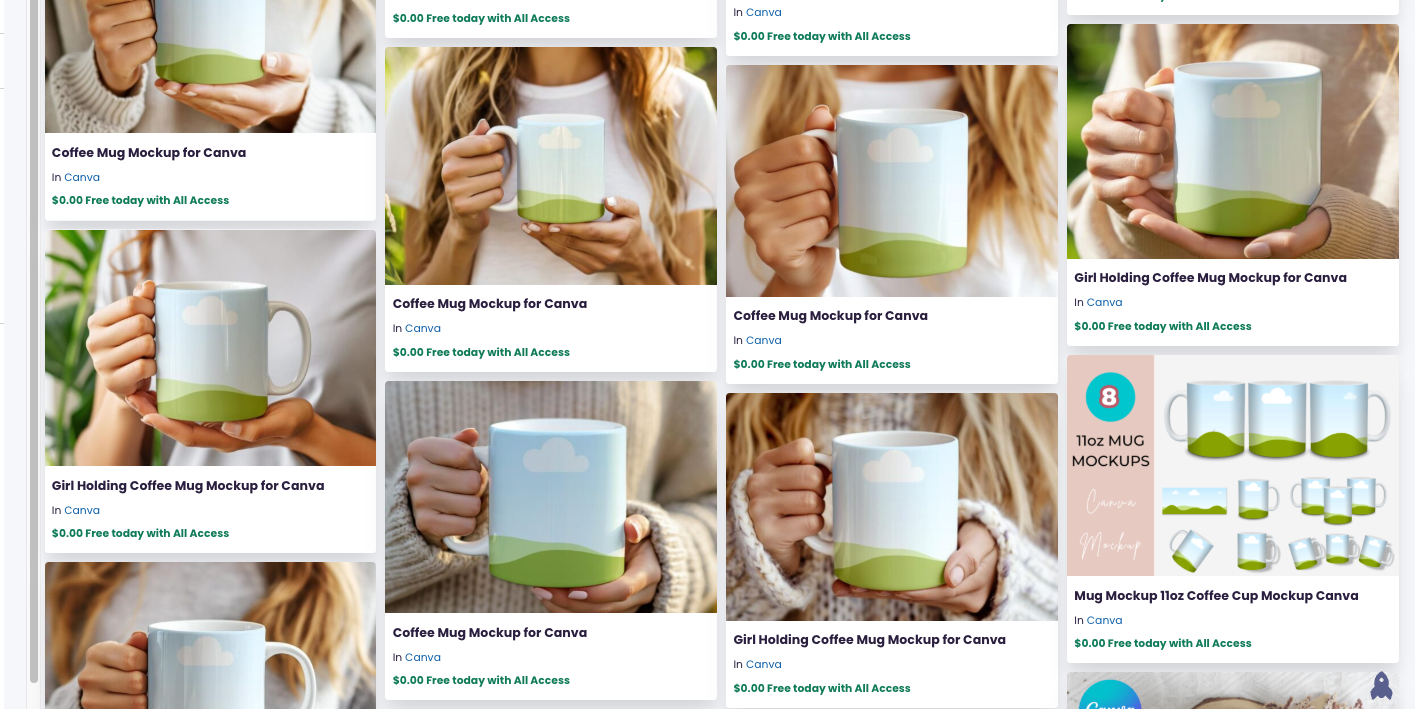 CreativeFabrica offers professional mug mockups that create trustworthy Amazon listings
One important rule to remember: Amazon requires your first product image (the main mockup) to be on a plain white background. This ensures your listing looks clean and meets Amazon’s standards. After that, you can upload additional lifestyle images or styled mockups to help your product stand out.
With mockups, you can create professional-looking product images in minutes — no photo studio, no cameras, no extra costs.
Uploading Products to Amazon
Once you’ve created your designs and mockups, the next step is to upload your mugs to Amazon. This can be done manually inside Seller Central.
The process is simple but a little time-consuming:
- Create a new product listing.
- Fill in the title, bullet points, and description.
- Upload your product images (starting with the white background mockup).
- Set your price and shipping.
If you’re just starting out, manual uploading works fine. You can list a few designs, test different niches, and get a feel for the process. The downside is that it can take a lot of time to upload products one by one — especially if your goal is to build a large catalog across hundreds of niches.
Uploading Products at Scale with PODtomatic
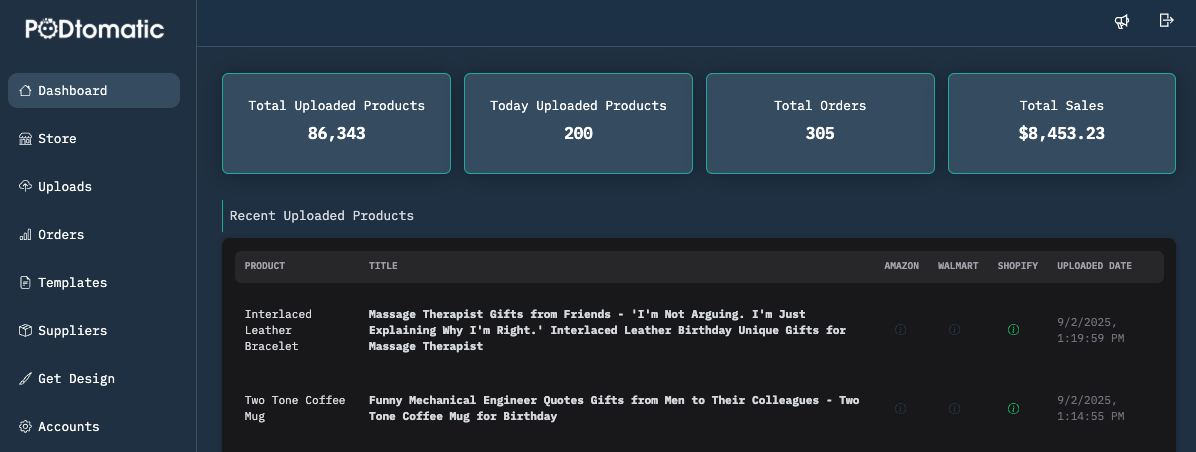 PODtomatic dashboard - Automate your Amazon product uploads at scale
Manually uploading mugs to Amazon works in the beginning, but it quickly becomes overwhelming if you want to scale across multiple niches. That’s where PODtomatic comes in.
With PODtomatic, you can upload up to 200 products per day automatically. Here’s how it works:
- Connect your Amazon account to PODtomatic.
- Set the number of products you want the system to upload each day (up to 200).
- Choose your pricing for the mugs.
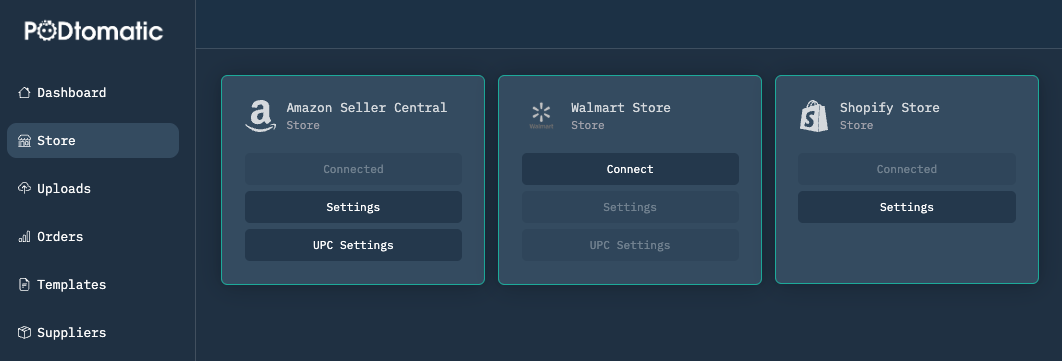 PODtomatic store connections - Connect your Amazon Seller Central and other platforms
That’s it. The system handles the rest.
Each listing comes with AI-generated titles, bullet points, and descriptions that are written to be both SEO-friendly and optimized for Amazon search. This means Amazon Ads can also use the keywords in your product content to automatically match your mugs with relevant searches.
Because PODtomatic spreads your designs across many niches, you end up casting a much wider net. Some niches won’t perform, but others will start generating consistent sales — and you don’t have to manually manage hundreds of uploads to find those winners.
The more listings you have live, the more chances you have to rank in Amazon search results and tap into free organic traffic. With automation, scaling becomes not only possible but easy.
Amazon Ads Strategy: The Evergreen Ads Method
Amazon is the world’s biggest shopping search engine — but it’s also pay-to-play. If you want your mugs to be discovered quickly, you need to run Amazon Ads. The good news is you don’t have to spend a fortune. My approach, which I call The Evergreen Ads Method, is designed to keep ad spend low while focusing on niches that sell year-round.
Why Ads Matter
Even with great designs and keywords, it takes time for new listings to rank organically. Ads give your mugs instant visibility, especially in competitive niches. And since you only pay when someone clicks, your costs stay manageable.
One Campaign = One Niche
The foundation of this method is creating one ad campaign per niche. For example:
- Engineer mugs → 1 campaign
- Nurse mugs → 1 campaign
- Teacher mugs → 1 campaign
- Gamer mugs → 1 campaign
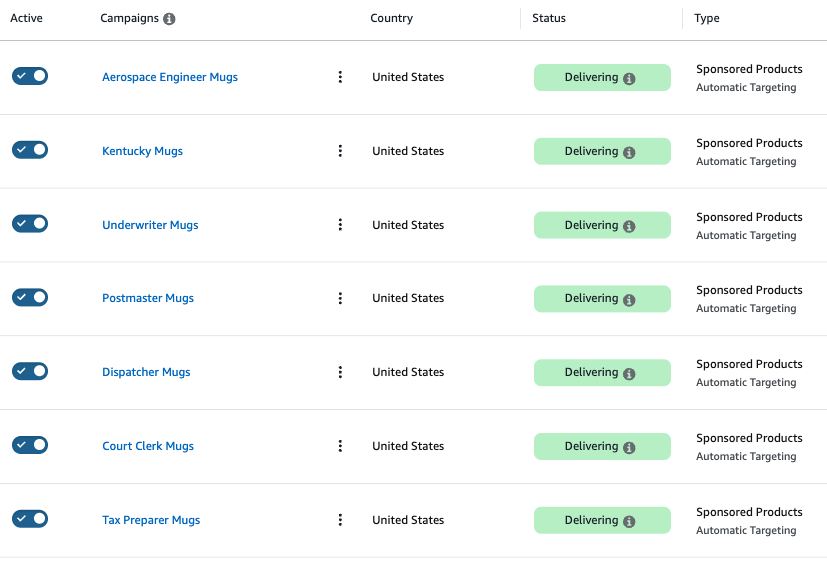 Amazon campaigns dashboard showing multiple active campaigns
Over time, this can scale to 500+ campaigns. But instead of launching them all at once, you roll them out gradually, focusing first on niches that show sales or potential.
Step-by-Step: Creating a Campaign
- Go to Amazon Campaign Manager and click Create Campaign.
- Select Sponsored Products.
- Select Automatic Targeting.
- Search for the niche (e.g., Engineer Mug, Nurse Mug, Teacher Mug).
- Add all relevant mugs from that niche.
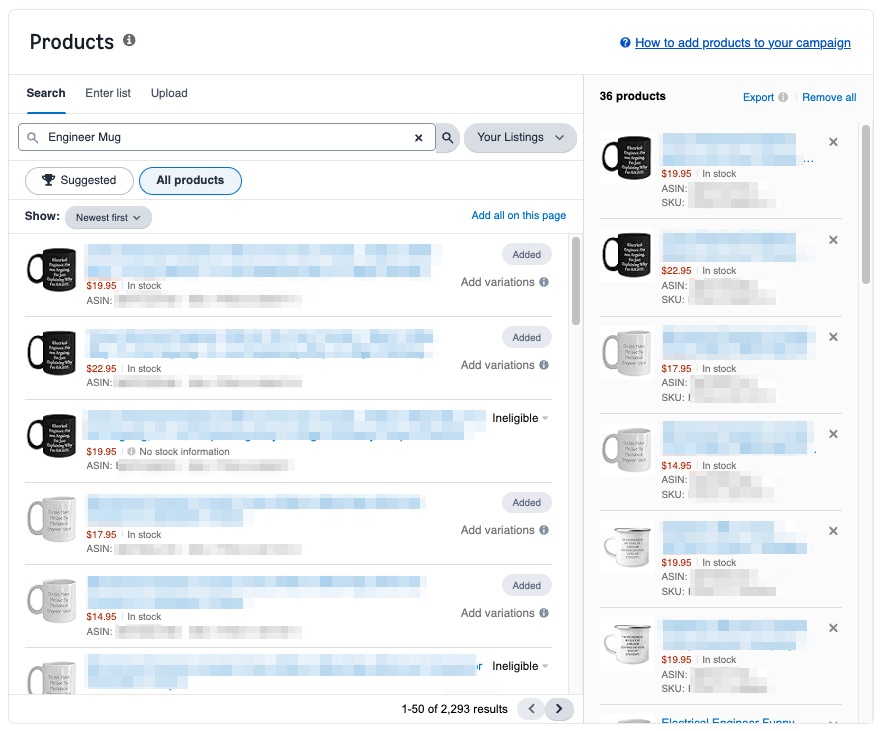 Product selection interface in Amazon Campaign Manager
- Double-check and remove any products that aren’t mugs.
- Set the suggested bid (Amazon recommends this automatically).
- Set a daily budget of $5/day.
- Launch the campaign.
💡 Why This Works
-
Low spend, year-round demand: Each campaign is capped at $5/day, but most niches won’t even spend the full budget. Because these are evergreen niches, you can keep ads running indefinitely, bringing in consistent sales over time.
-
Built-in buyer intent: People on Amazon are already ready to buy. If someone searches for “Funny Nurse Mug”, they’re not browsing casually — they’re ready to purchase.
-
Auto-targeting advantage: Amazon automatically finds related search terms based on your product listings. Learn more about Amazon Ads strategies in our complete guide.
🚀 PODtomatic Advantage: This is where using PODtomatic gives you an extra edge. The system uploads products with AI-written content that includes both the main niche keyword (like Nurse Mug) and a range of related keywords (like Funny Nurse Gift or Coffee Cup for Nurses). The richer your product content, the better Amazon can target your ads to the exact buyers who are already searching for mugs in that niche.
- Easy to scale: Only keep campaigns that generate sales. Let the others stop. Over time, you’ll build a portfolio of niche campaigns that continue producing results without constant babysitting.
The Evergreen Ads Method in Action
By combining low daily budgets with evergreen niches, you can run hundreds of campaigns throughout the year without overspending. Some campaigns may only bring a handful of sales each month, but across 500+ niches, those sales add up into a reliable, passive income stream.
The Evergreen Ads Method: The ads keep running quietly in the background, producing steady sales all year long.
Results: Real Numbers From Amazon Ads
 Real Amazon advertising performance metrics from running mug campaigns
After setting up my campaigns, I mostly let them run on their own. I rarely go back to check or tweak them, which shows just how passive this system can be once it’s in motion.
Here are the real numbers from running mug campaigns on Amazon:
- Clicks: 9,332
- Ad Spend: $8,069.16
- Orders: 1,240
- Total Sales: $24,550.86
That works out to a cost per order of about $6.50. Since I make roughly $10 profit per mug after Amazon fees and product costs (before ads), that leaves me with about $3.50 net profit per order once ad spend is factored in.
Multiply that across 1,240 orders, and these campaigns have generated around $4,000 in profit so far — all while running almost completely on autopilot.
The lesson here is that you don’t need to micromanage every campaign. With the Evergreen Ads Method and enough products uploaded, the system takes care of itself and turns into a reliable, passive income stream.
Lessons Learned
Looking back, here are the biggest takeaways from building and scaling this mug business on Amazon:
Mugs beat other POD products I’ve tested different print-on-demand products, but mugs consistently sell faster and easier. They’re affordable, giftable, and universally understood, which makes them much easier to move than t-shirts or hoodies.
Volume + speed = rankings The more mugs you upload, the more chances you have to get discovered. Pair that with fast fulfillment from CustomCat, and your FBM listings can compete directly with FBA products in Amazon search results.
Ads are safe when done right Running ads might feel risky at first, but with niche targeting and low daily budgets, costs stay under control. Since Amazon buyers already come with purchase intent, conversion rates remain strong.
Repeatable designs scale best You don’t need to reinvent the wheel for every mug. Simple, text-based templates that can be adapted to hundreds of niches are the fastest way to scale.
Action Plan for Beginners
If you’re ready to start selling mugs on Amazon with print on demand, here’s the step-by-step roadmap you can follow:
Step 1: Create an Amazon Professional Seller account Sign up for a Pro Seller account ($39.99/month) to unlock all the tools you need to sell at scale.
Step 2: Apply for a GTIN Exemption This allows you to list mugs without needing UPC barcodes. The process is free and takes only a few minutes.
Step 3: Choose a fast, reliable POD supplier I recommend CustomCat, which produces mugs in 2–3 days and ships quickly enough to compete with FBA products.
Step 4: Create and upload your first mugs Start small by manually uploading designs to learn the process. Once you’re ready to scale, tools like PODtomatic can automate uploads and create hundreds of listings per day.
Step 5: Launch ads in 5–10 niches Use The Evergreen Ads Method: create one automatic targeting campaign per niche with a $5 daily budget.
Step 6: Scale up gradually Expand into more niches over time. Some campaigns will fail, but others will bring steady sales. As you grow, you can easily scale into hundreds of campaigns that run year-round.
Conclusion
Selling on Amazon doesn’t have to mean stocking inventory, running a warehouse, or figuring out FBA. With print on demand, you can build a business around everyday products people already want — and coffee mugs are the perfect place to start.
The formula is simple: Coffee mugs + POD designs + The Evergreen Ads Method = passive Amazon income.
No inventory. No photoshoots. No shipping headaches.
Just create designs, upload them, run simple ads, and let Amazon’s massive search engine do the rest.
If you want to scale faster without spending hours uploading products one by one, that’s exactly what PODtomatic was built for. It automates uploads, creates SEO-friendly product content, and helps you cover hundreds of niches in a fraction of the time — giving you more chances to rank, more campaigns to run, and more sales on autopilot.
👉 Ready to build your own Amazon mug business? Try PODtomatic today and start turning simple designs into real passive income.